 SolarMind
How SolarMind decides when to charge, hold or export your battery
If you have solar panels and a home battery, you have probably asked yourself the same question many times. Should I charge the battery from the grid tonight? Should I keep the solar for later? Or should I export it now?
On a fixed tariff the answer barely matters. On a smart tariff like Octopus Agile it matters a lot, because the price of electricity changes every half hour. That means 48 different prices every day, and 48 chances to get it right or wrong.
SolarMind was built to make those decisions for you.
The problem with simple battery timers
Most home batteries come with a basic schedule: charge between midnight and 5am, discharge in the evening, and repeat. It is easy to set up, but it ignores what actually happens on any given day.
- Some nights are much cheaper than others.
- Some days are sunny and your panels will fill the battery for free, so charging from the grid overnight wastes money.
- Some evenings export prices are high enough that selling energy back beats using it.
- If you have an EV, its charging can clash with the battery and push you into expensive slots.
A fixed timer cannot see any of this. Some tools try to help by grouping the day into a few price bands, but that throws away most of the detail Agile gives you.
How SolarMind works
SolarMind looks at every one of the 48 half hour slots in the day and chooses one of three actions for your battery:
- Charge when electricity is cheap, or when your solar is producing more than the house needs.
- Hold when it is better to keep stored energy for a more expensive time later.
- Export when the price you are paid makes selling worth more than keeping.
To make these choices, SolarMind combines:
- Your tariff prices, pulled automatically for your region
- Your solar forecast, so it knows how much free energy is coming
- Your home’s usage pattern, so the battery is not empty when you need it
- Your EV and heat pump, so big loads land in cheap slots
Why we use reinforcement learning
Instead of writing thousands of fixed rules, we trained an AI agent using a method called reinforcement learning. The agent practised on simulated homes for more than 10 million steps, learning from each decision whether it saved money or cost money. Over time it learned patterns that simple rules miss, such as when holding energy through a cheap afternoon pays off later in the evening peak.
Real savings from SolarMind users
SolarMind is already running in real UK homes. Here are savings from users running SolarMind on Octopus Agile and Flux over one week.
Home 1: Octopus Agile. Big swings, big wins.
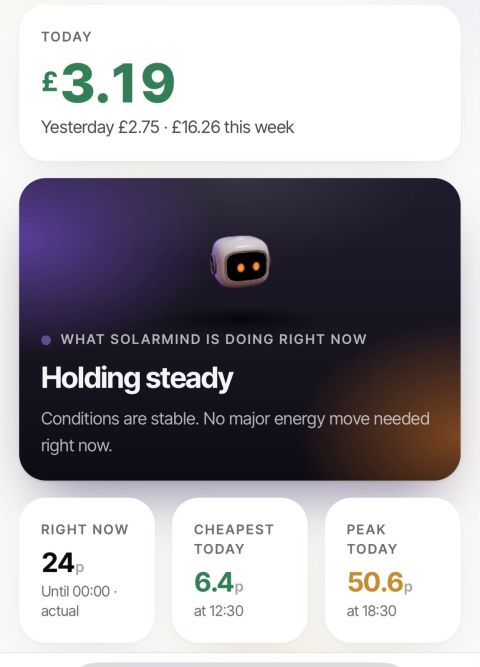
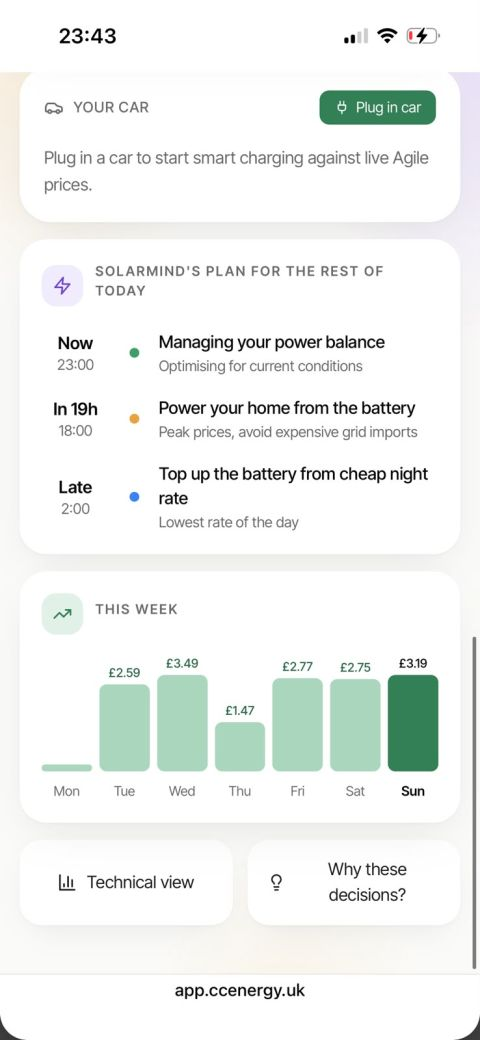
On Agile, prices can move a lot in a single day. On one Sunday they went from 6.4p to 50.6p per kWh. SolarMind charged the battery when power was cheap and ran the house from it during the peak.
- Saved this week: £16.26
- At that pace: roughly £70 a month
Home 2: Octopus Flux. Quiet and steady.
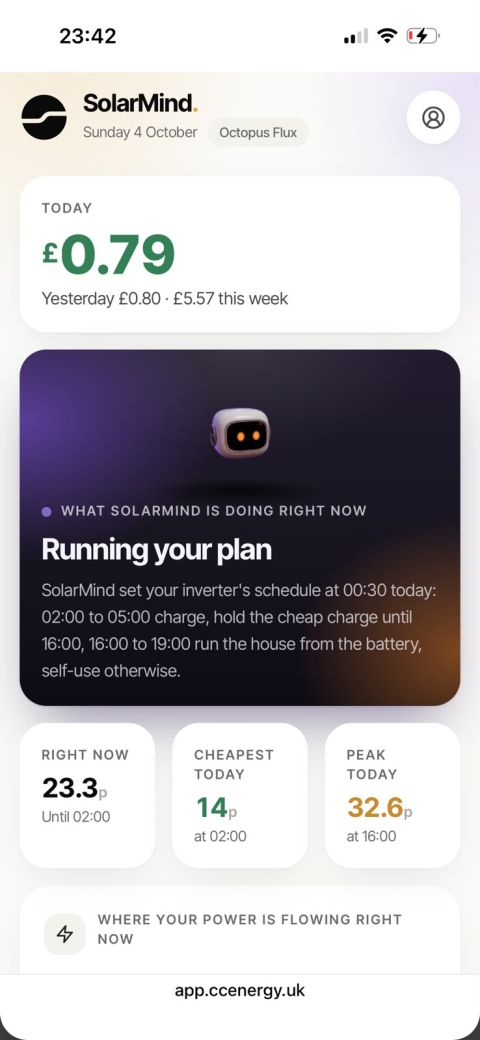
Flux has fixed cheap, standard and peak periods. Every morning SolarMind set the inverter schedule on its own: charge at 2am, hold that cheap energy, then power the house through the 4pm to 7pm peak.
- Around 80p saved every day
- Saved this week: £5.57, roughly £24 a month
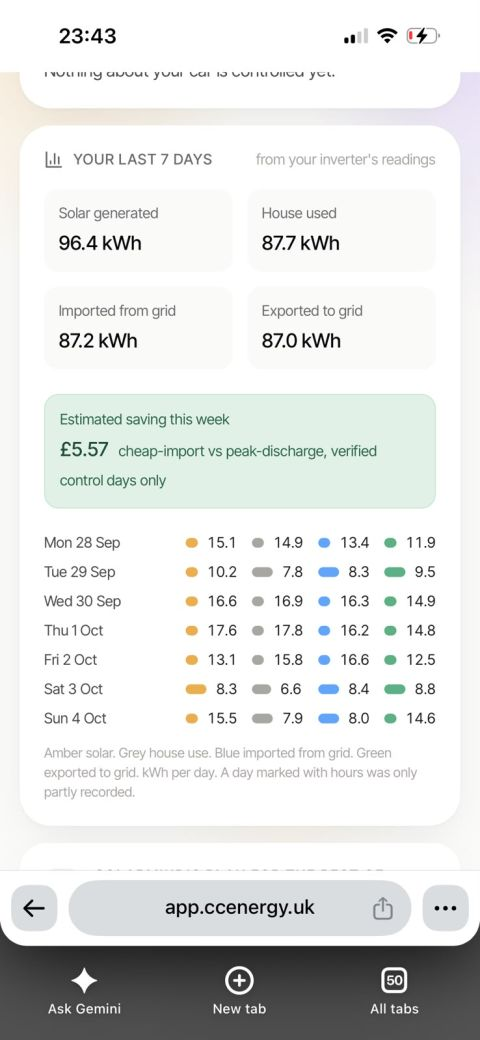
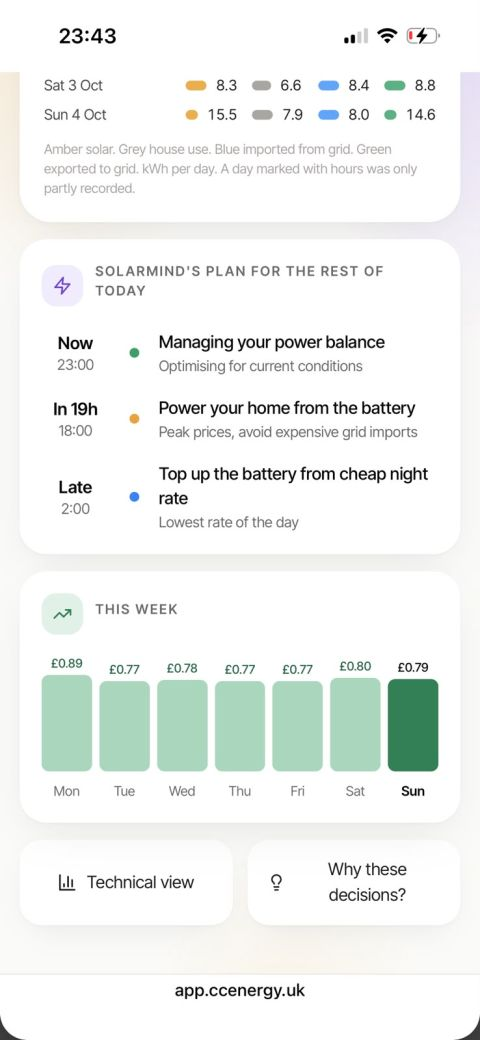
Different tariffs need different strategies. Agile rewards chasing price swings. Flux rewards discipline. SolarMind adapts to each one, and neither homeowner had to open an app or check a price.
Sometimes the smartest move is to do nothing. When no action is worth taking, the SolarMind dashboard simply shows “Holding steady”. Good energy management is not constant action. It is the right action at the right half hour.
These are early results from a small number of homes over one week. Savings will vary by home, battery size, tariff and season. We will keep publishing updates as more homes join.
Does it work with my system?
SolarMind works with a wide range of inverters and batteries. It can connect directly to your inverter, or run through Home Assistant if you already use it. There is no new hardware to buy.
We like to say: the hardware is the asset, the software is the yield. You have already invested in panels and a battery. SolarMind helps you get more value out of them every day.
Who is behind SolarMind?
SolarMind is built by Cotswold Cleantech Energy, a startup based in Cheltenham, Gloucestershire. Our work has been featured in the Cheltenham Times and Punchline Gloucester.
Get started with SolarMind for free
If you have solar, a battery or an EV and you are tired of checking apps and guessing when to charge, let SolarMind handle it.
SolarMind is free to use. Sign up at solarmind.uk or email us at [email protected].
Get started for freeView the full user dashboards

